
For most pet parents, our dogs and cats aren't just animals; they’re family members. When we look at smart home technology, our first question isn't usually "How cool is this?" but rather, "Is it safe for my pet?"
Automating a sliding glass door involves moving a heavy panel of glass and metal. Whether you are worried about a tail getting caught or an emergency exit during a fire, safety is the most critical factor in your buying decision.
In this second installment of our comparison series, we’re evaluating the three leading US systems—Wayzn, Autoslide, and SmartSlydr—through the lens of pet door safety. We’ll break down how they detect obstructions, how they handle emergencies, and the physical risks of their mounting designs.
Why "Good Enough" Isn't Enough for Our Pets
Most automatic doors are designed to stop if they hit something. While this is a standard safety feature, we believe the best safety measure is one that prevents contact from happening in the first place. When comparing these systems, look for the difference between reactive safety (stopping after contact) and proactive safety (preventing contact).
Obstruction Detection: Seeing vs. Feeling
The way a door responds to an obstruction—whether that’s a lingering Golden Retriever or a child’s toy—is its most important safety "reflex."
Wayzn: The Power of Thermal Detection
Wayzn is currently the only system on the market that includes built-in heat detection. This industry-first thermal sensor identifies the body heat of a living being near the doorway.
If Wayzn is closing and detects heat, it doesn’t wait to make contact. It immediately stops, re-opens fully, and waits until the heat source (your pet) has cleared the area before attempting to close again. This proactive approach means the door can avoid touching your pet entirely.
Additionally, Wayzn features high-precision resistance detection. If a non-living object (like a shoe) is in the way, Wayzn senses the physical resistance, stops, and tries again. After three failed attempts, it remains open and alerts you.
Autoslide and SmartSlydr: The Resistance Standard
Both Autoslide and SmartSlydr rely on resistance detection as their primary safety mechanism.
-
Autoslide: If the door meets an obstruction while closing, the motor detects the surge in resistance, stops, and reverses.
-
SmartSlydr: Similarly, it detects physical resistance, reverses the door, and—if the obstruction remains—will eventually stay open and notify the user via the app.
While resistance detection is effective and reliable, it is a reactive technology. The door must physically make contact with the pet or object before it knows to stop.
Our Opinion: At Wayzn, we felt that "contact" was a step too far. We chose to invest in thermal sensors because the safest interaction is no interaction at all. Protecting a wagging tail is easier when the door "sees" it coming.
Emergency Egress: Getting Out When It Counts
In the event of a fire or emergency, every second matters. You need to know that your sliding door can be opened manually by anyone in the house—including children or guests.
Wayzn: Accessible and Intuitive
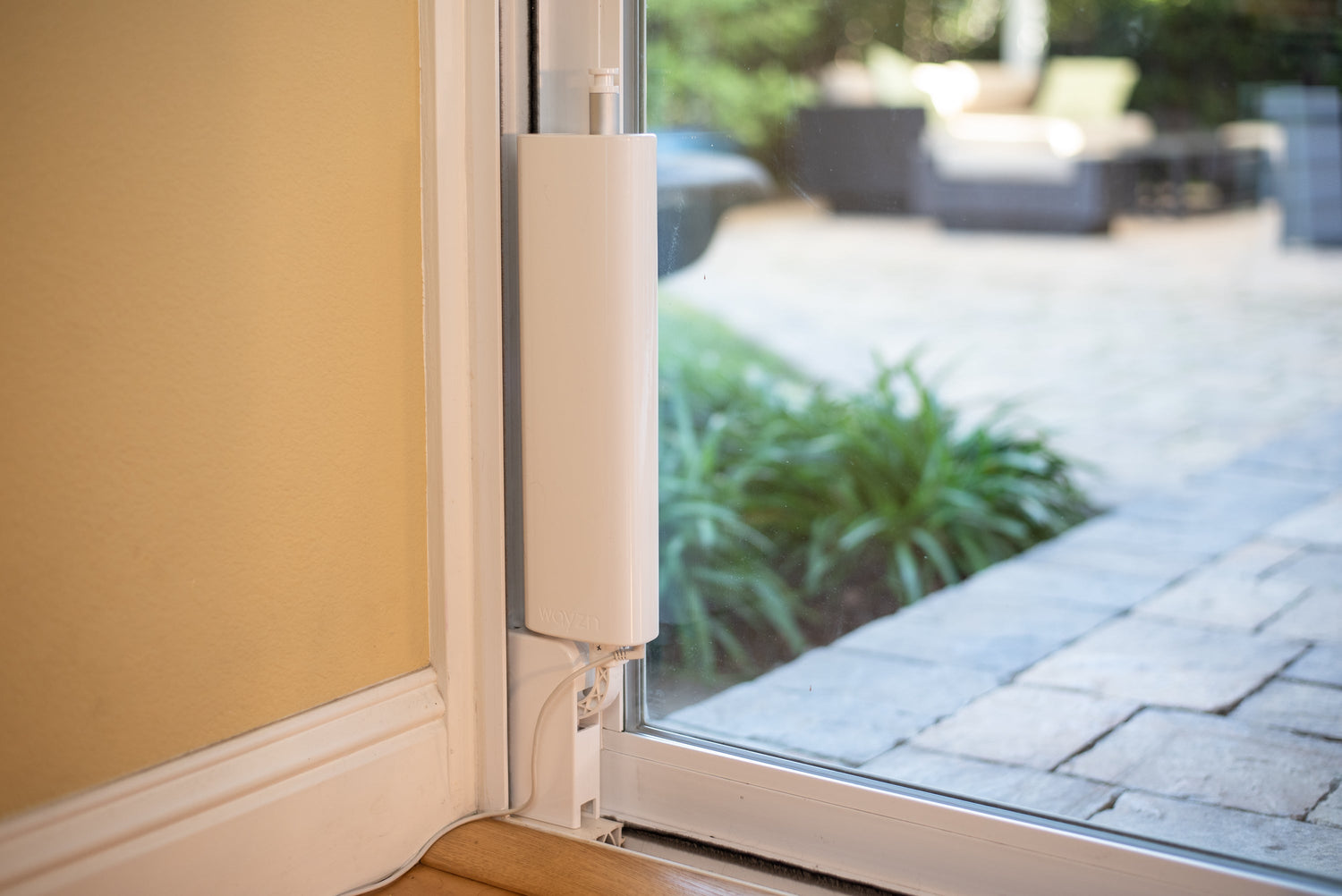
Wayzn was designed with emergency egress as a top priority. Because the device sits in the bottom track of the door, it is within arm’s reach of everyone, regardless of height.
-
The Pivot: Wayzn features a simple hinge. To open the door manually, you just pivot the device from its horizontal position to an upright position.
-
Retraction: Once pivoted, the device is completely out of the way, allowing the door to slide fully open by hand. It weighs only a few pounds and requires almost no force to move.
Autoslide: Disengaging the Motor
Autoslide is designed to disengage from the door if power is cut. Users must ensure the system is correctly configured to allow for this manual override, but as long as it works as designed this allows the door to be slid open manually.
SmartSlydr: The Pull Cord
SmartSlydr utilizes a manual release cord that hangs down from the unit (which is mounted at the top of the door).
-
The Mechanism: Pulling the cord disengages the motor from the door, allowing for manual operation.
-
The Risk: If the cord is not installed, or if it is tucked away for aesthetic reasons, the device can effectively lock the door in place, preventing manual egress. Furthermore, in a smoke-filled room, finding a thin cord hanging from the ceiling may be significantly more difficult than reaching for the door track.
The Gravity Factor: Mounting and Falling Risks
It’s an often-overlooked safety point: what happens if the mounting fails?
Wayzn: Ground-Level Stability
Because Wayzn sits inside the bottom track of your sliding door, it is essentially "pre-fallen." There is no risk of the device falling on a pet or person because it is already at ground level.
Autoslide and SmartSlydr: Overhead Hazards
Both of these systems are mounted at the top of the door casing, typically six to seven feet high.
-
Weight: These types of systems typically weigh approximately eight pounds.
-
Potential Failure: While these systems are designed to be secure, any device mounted overhead with screws or adhesive carries a non-zero risk of falling if the mounting surface fails or the installation wasn't perfect. An eight-pound metal object falling from seven feet could cause significant injury to a pet or a small child passing through the door.
Side-by-Side Safety Comparison
|
Feature |
Wayzn Smart Pet Door |
Autoslide |
SmartSlydr |
|
Detection Type |
Thermal (Heat) + Resistance |
Resistance Only |
Resistance Only |
|
Contact Required? |
No (with thermal) |
Yes |
Yes |
|
Emergency Egress |
Pivot up (Intuitive/Low) |
Disengages on power loss |
Pull cord (Manual) |
|
Mounting Position |
Bottom Track (No fall risk) |
Top Frame (Fall risk) |
Top Frame (Fall risk) |
|
App Notifications |
Yes (Persistent obstruction) |
Optional/Variant dependent |
Yes |
Final Verdict: The Safest Path Forward
When evaluating pet door safety, all three systems provide basic protection via resistance detection. However, the differences in how they handle the unexpected are clear.
-
Autoslide is a powerful, traditional system, but it relies on reactive safety and overhead mounting.
-
SmartSlydr offers smart features but introduces complexity with its manual release cord and overhead position.
-
Wayzn provides a multi-layered approach by combining proactive thermal sensing with an intuitive, pivot-to-disengage design.
Our Opinion: Why We Prioritize Preventive Safety
We believe that as a pet owner, you are your pet's hero. Part of that role is removing hidden risks. We built Wayzn to be "low and slow"—it stays out of the way, it doesn't hang over your head, and it uses heat-seeking technology to ensure it never has to "bump" your pet to know they are there.
For more information on keeping your pets safe and healthy, check out the American Kennel Club's guide to home safety.
Ready to give your pet the safest path to the backyard?
Learn more about Wayzn’s Thermal Sensors here.
